Introduction: The Market Is Moving Beyond Automation
The fully automatic coffee machine market is entering a new stage.
For years, automation was one of the category's strongest selling points. Consumers wanted to grind beans, brew espresso and prepare milk-based drinks with as little manual effort as possible.
In 2026, that promise is no longer enough.
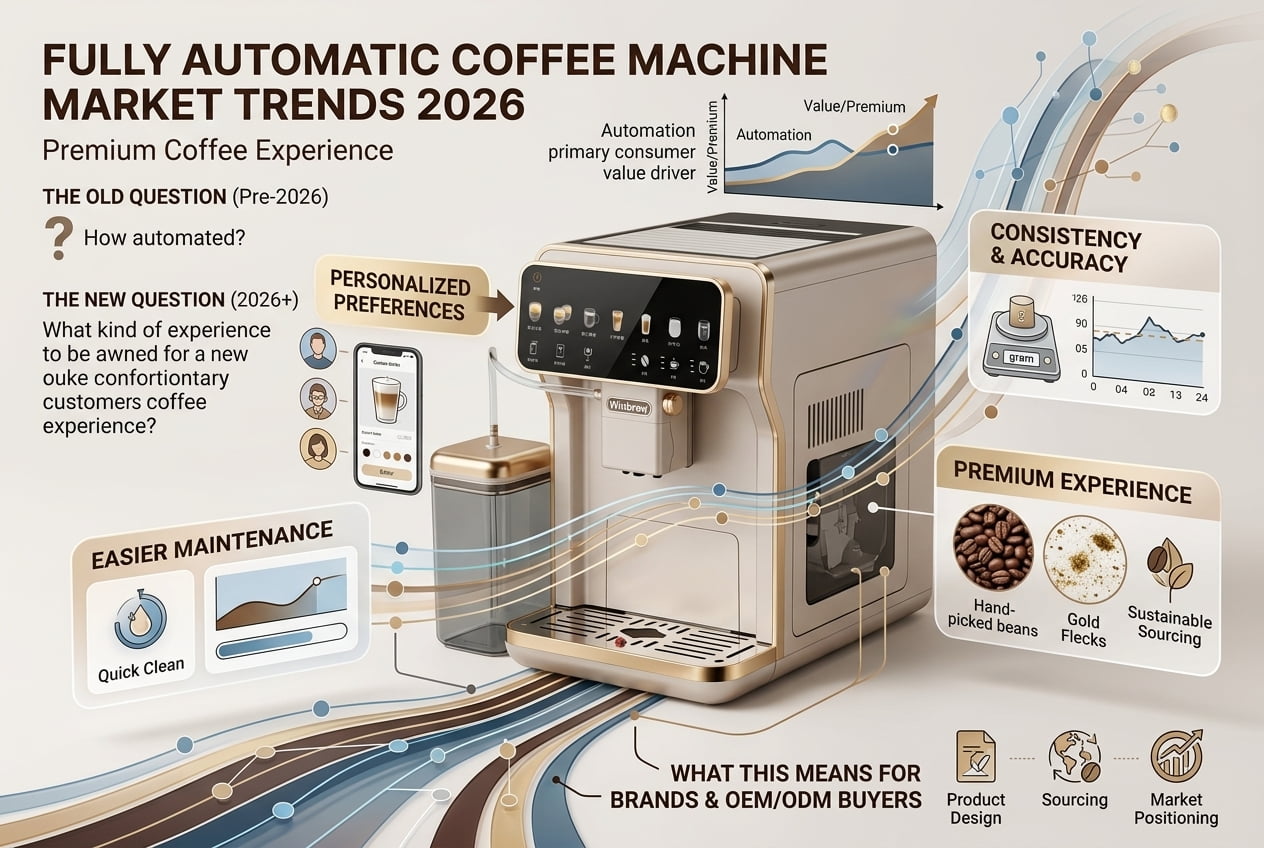
Consumers increasingly expect a coffee machine to deliver something broader: better coffee, greater consistency, personalized preferences, easier maintenance and a premium experience that fits naturally into everyday life.
For brands and B2B buyers, this changes the product development question.
It is no longer simply:
How automated should the machine be?
The more important question is:
What kind of coffee experience should the machine deliver — and which features are worth developing, manufacturing and supporting at scale?
This article explores the key trends shaping the fully automatic coffee machine market in 2026 and what they mean for brands, product managers, sourcing teams and OEM/ODM buyers.
2026 Market Snapshot: Where Is the Opportunity?
The broader European household coffee machine market is still expanding. Current market estimates put the European household coffee machine market at approximately USD 5.55 billion in 2026, with a projected CAGR of around 5.31% from 2026 to 2031.
The important point for B2B buyers is not simply that the market is growing.
The more interesting question is where value is moving within the category.
Several product and consumer trends are becoming increasingly important:
- Home café-style consumption
- Freshly ground coffee and bean-to-cup systems
- Premiumization
- Personalized beverage experiences
- Milk-based beverages
- Easier cleaning and maintenance
- Compact premium design
- Smart and connected features
- Sustainability and lifecycle considerations
For brands developing their next coffee machine, these trends suggest that competitive advantage will increasingly come from better product decisions rather than simply adding more functions.
1. The Home Café Trend Is Becoming Structural
For a period, the rapid growth of home coffee equipment was often viewed as a temporary consequence of the pandemic.
Consumers spent more time at home, cafés were less accessible, and many households invested in coffee equipment.
But the behavior has proven more durable than a temporary substitution effect.
Consumers have become more familiar with preparing better coffee at home, and many now view the coffee machine as part of their kitchen lifestyle rather than simply an appliance.
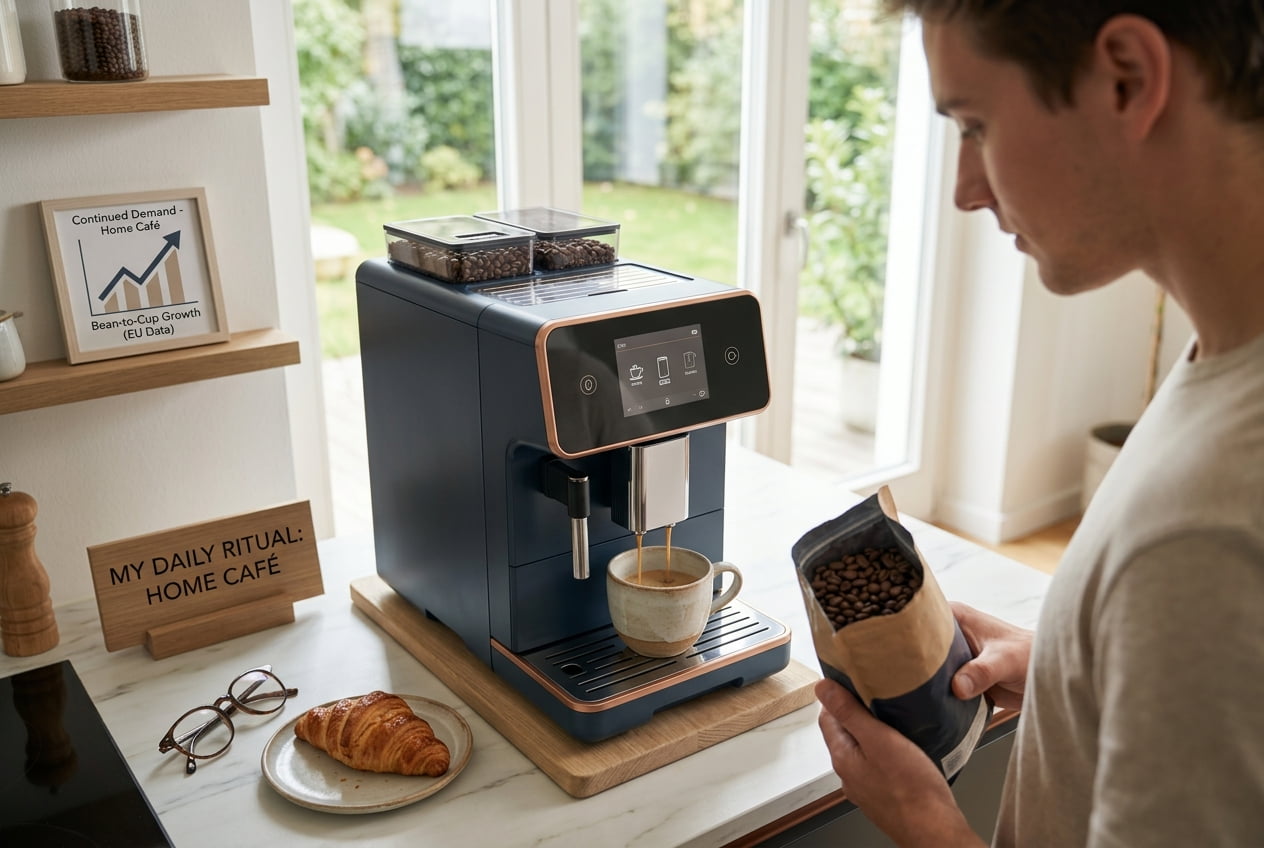
Recent market research points to continued demand for at-home café-style consumption, premium coffee experiences and automated preparation. More recent industry data also shows strong momentum behind whole-bean coffee and bean-to-cup machines in several European markets.
What This Means for B2B Brands
The opportunity is not simply to sell a machine that replaces a café visit.
The opportunity is to build a product that becomes part of the consumer's daily ritual.
That changes how brands should think about:
- Product aesthetics
- Countertop footprint
- Beverage variety
- User interaction
- Coffee quality
- Noise
- Cleaning
- Long-term reliability
- Packaging and unboxing
- After-sales experience
A successful product needs to fit the consumer's lifestyle as well as their coffee preferences.
2. Bean-to-Cup Is Gaining Momentum
One of the clearest product directions to watch is the continued development of bean-to-cup coffee machines.
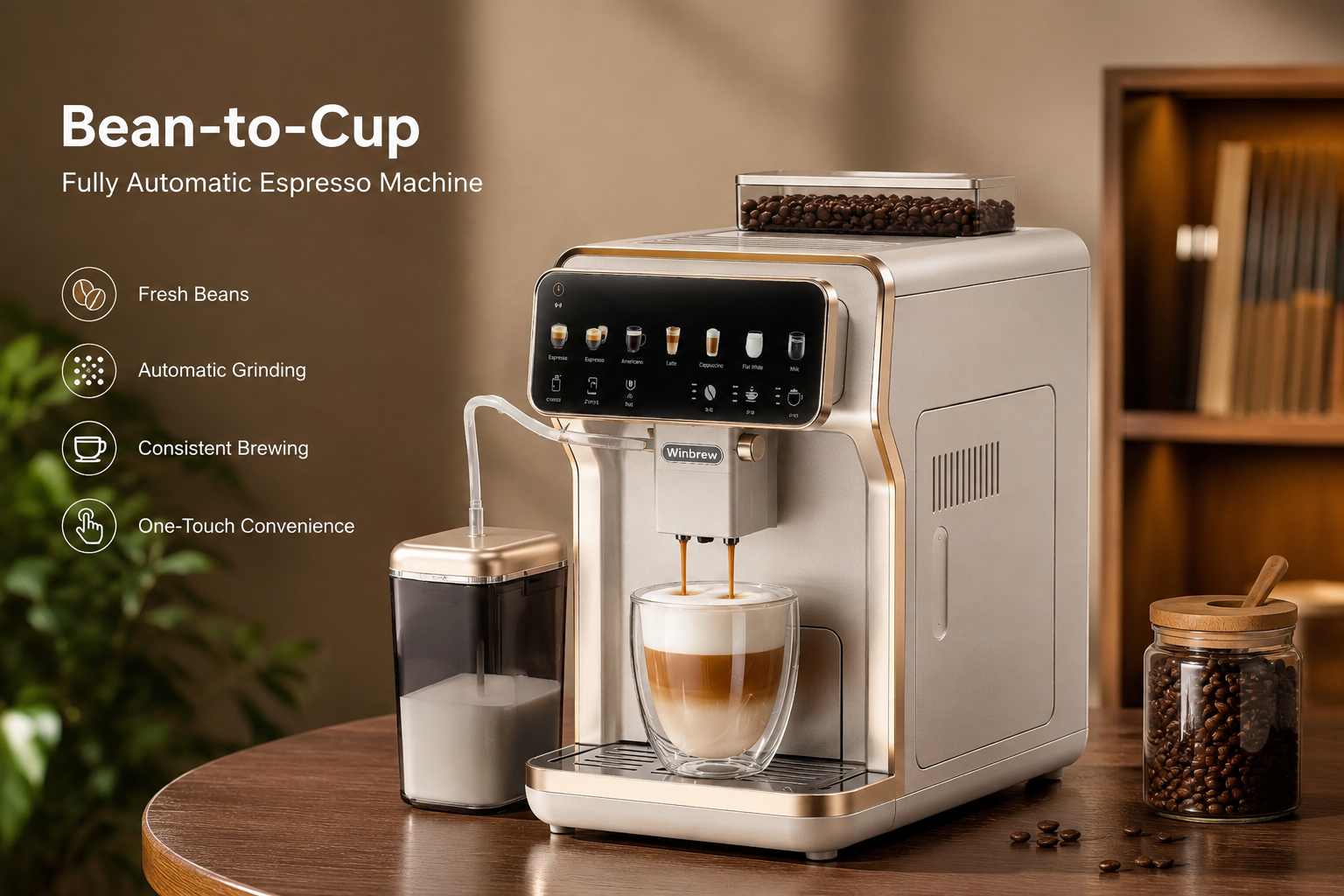
The basic value proposition is powerful:
Fresh beans + automatic grinding + consistent brewing + convenience
Consumers do not have to choose between freshly ground coffee and ease of use.
Recent market data also supports growing interest in whole-bean consumption and bean-to-cup equipment. In the UK, whole-bean coffee sales increased significantly in the year to May 2026[^1], while unit sales of bean-to-cup machines also recorded strong growth. Similar whole-bean growth was reported in France, Italy and Germany.
For B2B product teams, this creates an important product-development opportunity.
Freshness Is Becoming Part of the Product Story
The built-in grinder is not simply a convenience component.
It is part of the machine's quality proposition.
Consumers increasingly associate whole beans with:
- Freshness
- Aroma
- Coffee quality
- Customization
- A more authentic coffee experience
That means grinder performance, grind consistency and bean handling can influence how consumers perceive the entire machine.
Consistency Matters as Much as Freshness
Fresh beans alone do not guarantee a good result.
A machine must also deliver repeatable performance over time.
From a product development perspective, consistency can be affected by:
| ComponentKey Considerations | |
|---|---|
| Grinder | Burr quality, grind consistency, heat management |
| Brewing system | Temperature stability, pressure control, repeatability |
| Water system | Water quality, filtration and descaling |
| Software / control logic | Repeatable brewing profiles |
| Mechanical system | Component durability and calibration stability |
For B2B brands, this leads to a broader lesson:
A premium coffee machine is not defined by how good the first cup tastes. It is defined by how consistently the product performs over its lifetime.
3. Premiumization Is About the Ownership Experience
Premiumization used to be associated primarily with:
- Higher-end materials
- Stainless steel
- Larger displays
- More buttons
- More drink recipes
- Higher prices
That definition is becoming less useful.
In 2026, a premium fully automatic coffee machine is increasingly defined by the total ownership experience.
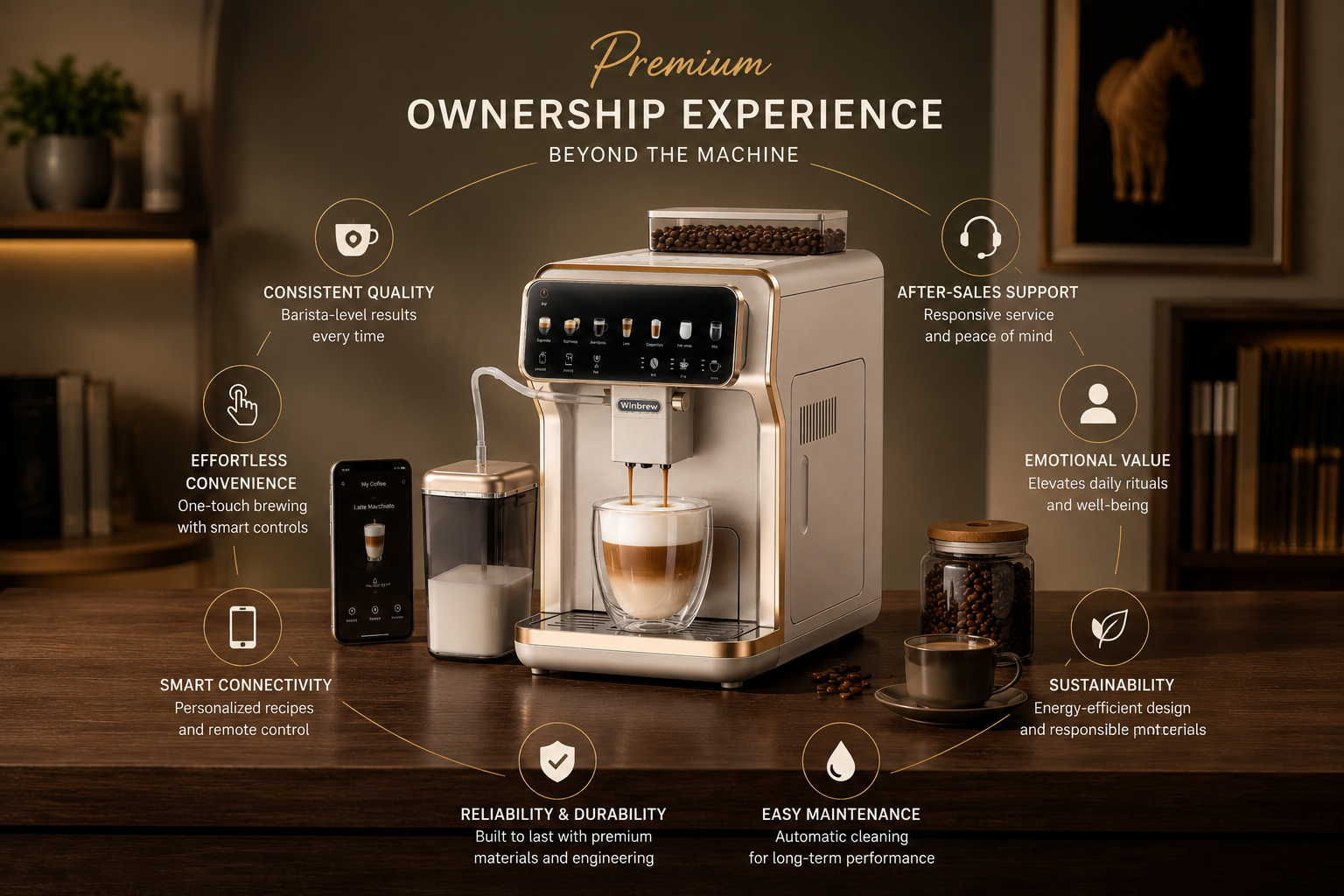
Consumers interact with the product through many different touchpoints:
Unboxing
Does the product immediately feel well designed?
Setup
How quickly can a new user make the first coffee?
Daily Use
Is the workflow intuitive?
Is the machine quiet?
Does it produce consistent results?
Cleaning
How difficult is maintenance?
Can components be removed easily?
Troubleshooting
Does the machine clearly explain what needs attention?
Long-Term Ownership
Does performance remain stable after months or years of use?
This is where premiumization becomes particularly relevant to B2B product development.
Premium does not necessarily mean more features. Premium means less friction and more perceived value throughout the product lifecycle.
For brands, this creates an important strategic question:
Which features genuinely improve the ownership experience — and which simply increase BOM cost and product complexity?
4. Personalization Is Becoming a Genuine Differentiator
The original promise of a fully automatic coffee machine was simple:
One touch, one cup.
That remains valuable.
But in a crowded market, one-touch preparation alone may no longer be enough to differentiate a product.
The next step is personalization.
Consumers increasingly expect coffee machines to adapt to individual preferences.
Potential personalization features include:
- Coffee strength memory
- Coffee volume adjustment
- Temperature settings
- Grind adjustment
- User profiles
- Favorite drinks
- Milk-to-coffee ratio
- Customized beverage recipes
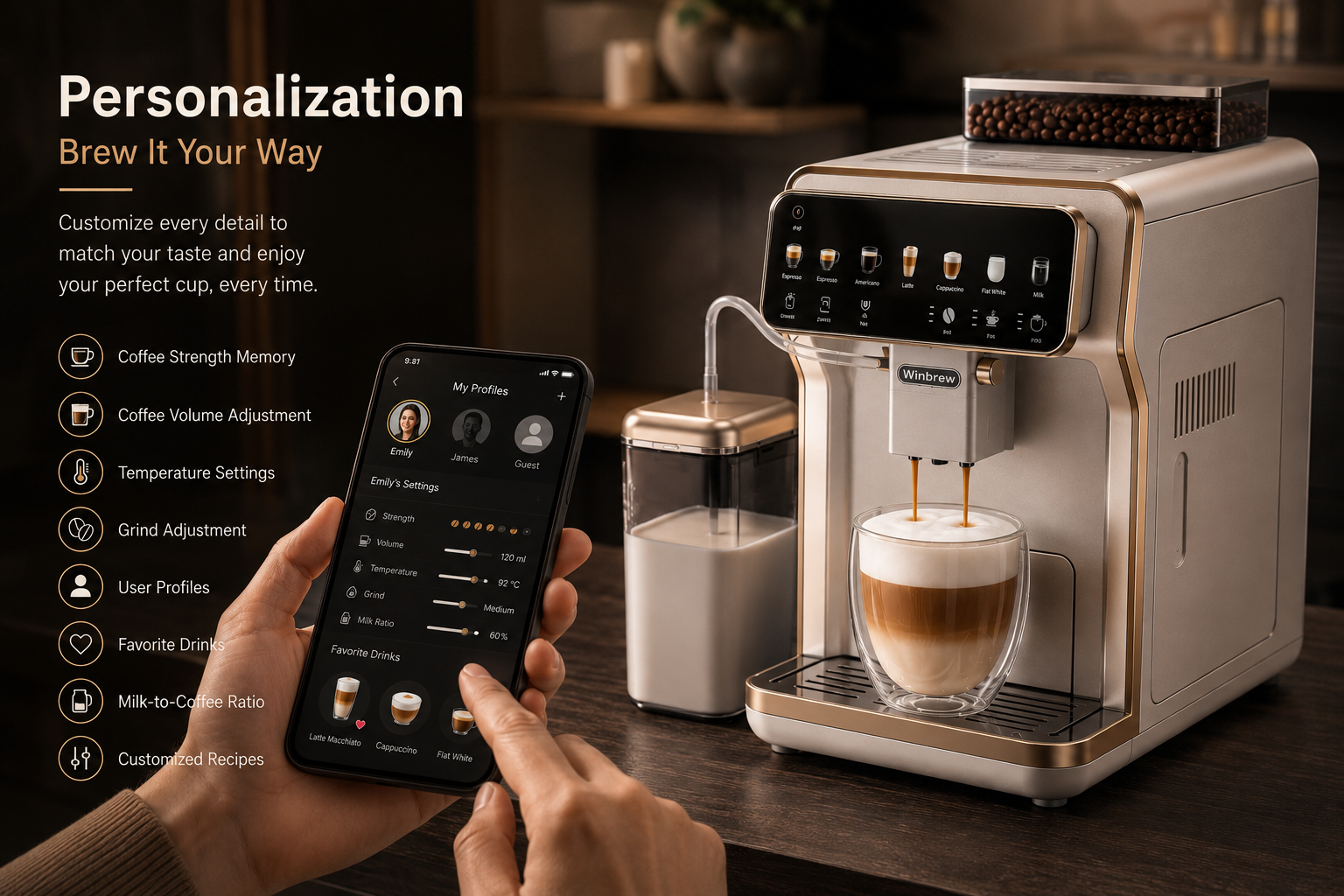
The important B2B question is not:
How many personalization functions can we add?
It is:
Which personalization functions are meaningful enough for the target consumer to justify their development and support costs?
This distinction is important.
Every additional feature can create:
More hardware → More software → More testing → More support → More cost
Therefore, effective product development is not about maximizing the feature list.
It is about selecting the features that create the strongest combination of:
Consumer Value × Product Differentiation × Commercial Viability
5. Milk Systems, Cleaning and Noise Are Becoming Hidden Battlegrounds
Traditional coffee machine marketing often focuses heavily on espresso quality, pressure and the number of available beverages.
But some of the most important everyday experiences happen outside the espresso extraction itself.
Three areas deserve more attention:
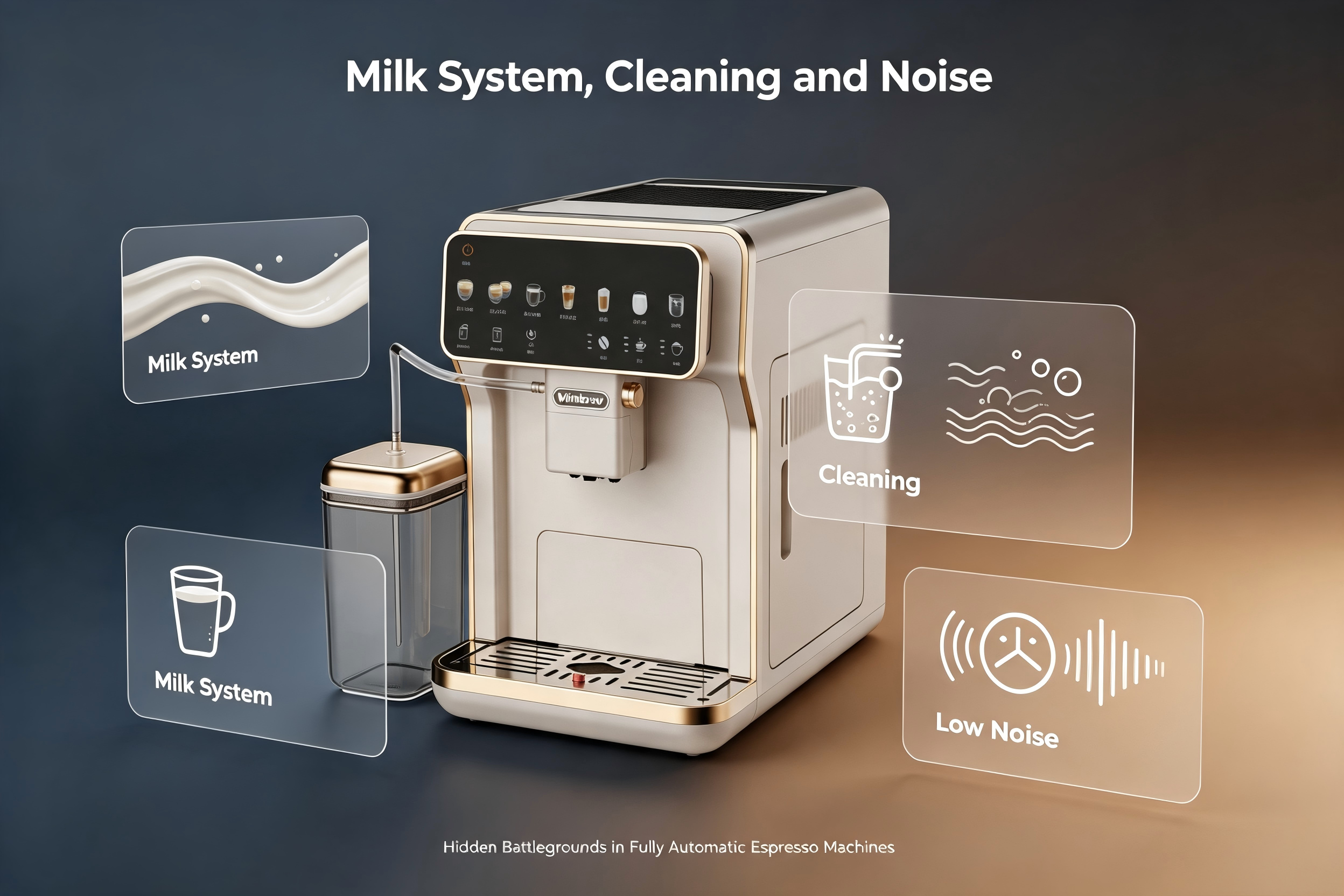
Milk Systems
Milk-based beverages such as:
- Cappuccino
- Latte
- Flat White
- Latte Macchiato
are central to the home café experience for many consumers.
The milk system therefore affects:
- Foam quality
- Temperature
- Convenience
- Beverage consistency
- Cleaning requirements
The growing importance of plant-based milk also makes milk-system performance a relevant consideration for product development.
Recent 2026 product testing has highlighted differences in how automatic and manual milk systems perform, including their ability to handle non-dairy milk and their impact on convenience.
Cleaning Experience
Coffee machines are used frequently, but cleaning is often underestimated during purchase.
This creates an important gap between:
Purchase Experience
and
Ownership Experience
Features such as:
- Automatic rinse cycles
- Removable brewing components
- Easy-access milk components
- Dishwasher-safe parts where appropriate
- Clear descaling guidance
can have a significant impact on perceived usability.
Operational Noise
Noise is another underappreciated product attribute.
The grinder, pump, motor and mechanical structure all contribute to the sound profile of a machine.
For consumers using a machine early in the morning, in open-plan kitchens or in shared living environments, noise can become a meaningful source of daily friction.
This is a strong example of a feature that may not dominate a specification sheet but can strongly influence real-world satisfaction.
6. Compact Premium Design Is Becoming More Relevant in Europe
European coffee machine markets are relatively mature, which changes what consumers and buyers expect from new products.
Instead of simply adding more functions, brands increasingly need to balance:
Performance + Design + Footprint + Usability
Compact product design is particularly relevant for urban households and space-constrained kitchens.
Recent 2026 product launches illustrate this direction, with new fully automatic machines combining relatively compact footprints with multiple beverage options, customization and premium features.
This creates an interesting product-development challenge:
How can a brand deliver a premium experience without making the machine unnecessarily large?
The answer may involve:
- More efficient internal architecture
- Modular component design
- Better water and bean-container placement
- Compact heating systems
- Integrated user interfaces
- Simplified mechanical structures
For OEM/ODM development, compact premium design can therefore become a meaningful area of differentiation.
7. Smart Features Need to Solve Real Problems
Connected coffee machines are another trend to watch.
But the question for B2B product teams should not be:
Can we add an app?
It should be:
What problem does connectivity solve for the consumer?
Potentially useful smart features include:
- User profile management
- Beverage customization
- Maintenance reminders
- Usage information
- Firmware updates
- Remote diagnostics
- Personalized drink recommendations
However, connectivity can also introduce:
- Higher development costs
- Software maintenance requirements
- App support
- Privacy considerations
- Additional customer-service complexity
The best smart features are therefore not necessarily the most sophisticated.
Smart connectivity should reduce friction, not create another layer of complexity.
For B2B buyers, this is an important product strategy question when evaluating the next generation of coffee machines.
8. Sustainability Is Moving Into Product Development
Sustainability is becoming more than a marketing message.
For products entering European markets, brands increasingly need to consider the entire product lifecycle:
- Energy efficiency
- Material selection
- Packaging
- Product durability
- Repairability
- Spare parts
- Product lifetime
- End-of-life considerations
Packaging is particularly relevant in 2026.
The EU Packaging and Packaging Waste Regulation (PPWR) entered into force in February 2025[^2] and generally begins applying from 12 August 2026, bringing new requirements around packaging waste, reuse and recyclability.
For coffee machine brands, this means packaging decisions should increasingly be considered during product development rather than only after the product itself has been finalized.
Sustainability therefore becomes part of:
Product Design → Packaging → Supply Chain → After-Sales → Product Lifecycle
rather than a separate marketing topic.
9. The Real B2B Opportunity: Better Feature Selection
Looking across these trends, one common pattern becomes clear.
The next generation of fully automatic coffee machines will not necessarily win by simply adding more features.
Instead, successful products will need to balance four variables:
Consumer Experience
Does the product solve a real consumer need?
Product Differentiation
Does the product offer a reason to choose it over alternatives?
Commercial Viability
Can the target retail price support the product's cost structure?
Manufacturability
Can the product be produced reliably, consistently and at scale?
This is where product development becomes more complicated than simply selecting a specification list.
For example:
More drinks
may increase consumer appeal,
but also increase:
Software complexity + components + testing + support
Similarly:
More customization
may improve perceived value,
but can also increase:
Development cost + user complexity + after-sales requirements
The goal is therefore not:
More Features
The goal is:
Better Feature Selection
What These Trends Mean for B2B Product Development
For brands planning a new fully automatic coffee machine in 2026, the key questions should include:
1. What consumer problem are we actually solving?
Is the product primarily about:
- Convenience?
- Coffee quality?
- Personalization?
- Milk beverages?
- Premium design?
- Compact living?
A clear product proposition should come before the feature list.
2. Which features create meaningful consumer value?
Not every feature deserves to be included.
The product team should evaluate:
Consumer Value × Development Cost × BOM Impact × After-Sales Complexity
3. Can the product maintain consistent performance?
Coffee quality needs to remain stable across:
- Different beans
- Different usage frequencies
- Different water conditions
- Long-term operation
4. Is maintenance simple enough?
Cleaning and servicing should be considered during the initial engineering stage rather than treated as an afterthought.
5. Does the product fit the target market?
A product designed for a large kitchen environment may not be ideal for compact European households.
Target market should influence:
- Footprint
- Design language
- Beverage portfolio
- User interface
- Packaging
- Compliance
- Service strategy
6. Can the product be manufactured at the target cost and quality level?
A concept can look excellent on paper but still fail commercially if:
- BOM cost is too high
- Tooling is too complex
- Assembly is inefficient
- Components are difficult to source
- Reliability is insufficient
- After-sales costs are excessive
This is why early collaboration between product design, engineering, sourcing and manufacturing is increasingly important.
From Market Trends to Product Development
Understanding market trends is only the first step.
The real challenge is translating those trends into a commercially viable product.
The strongest OEM/ODM partnerships are not simply about manufacturing an existing specification.
They can help brands evaluate:
- Which features are worth developing
- Which components influence performance
- How to balance BOM and retail positioning
- How to simplify the product architecture
- How to improve reliability
- How to prepare the product for mass production
For brands entering the fully automatic coffee machine category, this product-development perspective can be just as important as the manufacturing capacity itself.
2026 B2B Buyer Checklist
Before starting a new fully automatic coffee machine project, brands and sourcing teams should consider:
- Is the target consumer clearly defined?
- Is the product proposition differentiated?
- Does the machine deliver consistent coffee quality?
- Is the grinder system appropriate for the target positioning?
- Is the milk system competitive?
- Is cleaning simple enough for everyday use?
- Is operational noise acceptable?
- Are personalization features genuinely valuable?
- Is the product footprint suitable for the target market?
- Can the BOM support the intended retail price?
- Has reliability been considered from the beginning?
- Are European market requirements being considered early enough?
- Can the product be manufactured consistently at scale?
- Is the after-sales and spare-parts strategy realistic?
Conclusion: The Next Opportunity Is Better Coffee Experiences
The fully automatic coffee machine market in 2026 is not simply about making coffee more automatic.
The broader opportunity is to make the entire coffee experience better.
Consumers are becoming more interested in fresh beans, consistent coffee, personalization and café-style beverages at home. At the same time, they are becoming more sensitive to the everyday realities of ownership — including cleaning, noise, footprint, reliability and long-term value.
For B2B brands, this creates an important product-development opportunity.
The winners may not necessarily be the machines with the longest feature list.
They will be the products that find the right balance between:
Coffee Quality
Convenience
Personalization
Design
Reliability
Cost
Manufacturability
Ultimately, the question is not:
How many features can we put into a coffee machine?
It is:
How can we create a better coffee experience that consumers value — and a product that brands can successfully manufacture, position and scale?
That is where the next generation of fully automatic coffee machine opportunities lies.
[^1]: "UK Coffee Statistics (updated 2026)", https://www.lavazzapro.co.uk/blog/uk-coffee-statistics/. Market data indicates significant growth in whole-bean coffee sales in the UK in the year to May 2026, suggesting increased consumer preference for freshly ground coffee at home. Evidence role: statistic; source type: research. Supports: the reported increase in whole-bean coffee sales in the UK market during the specified period. Scope note: Sales growth may reflect multiple factors including price changes, distribution expansion, or shifts from other coffee formats rather than purely demand-driven increases. [^2]: "Packaging waste - Environment - European Commission", https://environment.ec.europa.eu/topics/waste-and-recycling/packaging-waste_en. The EU Packaging and Packaging Waste Regulation (PPWR) entered into force in February 2025, establishing new requirements for packaging across member states. Evidence role: historical_context; source type: government. Supports: the entry into force date of the EU Packaging and Packaging Waste Regulation.